Pratham Sood
Director
Joshua M. Capps
Founder, Architect

Split-Brain in 5G RAN: Verifying Deterministic Identity Continuity

Phase 1 Validation- Controlled Failure Scenarios in Distributed Edge Infrastructure

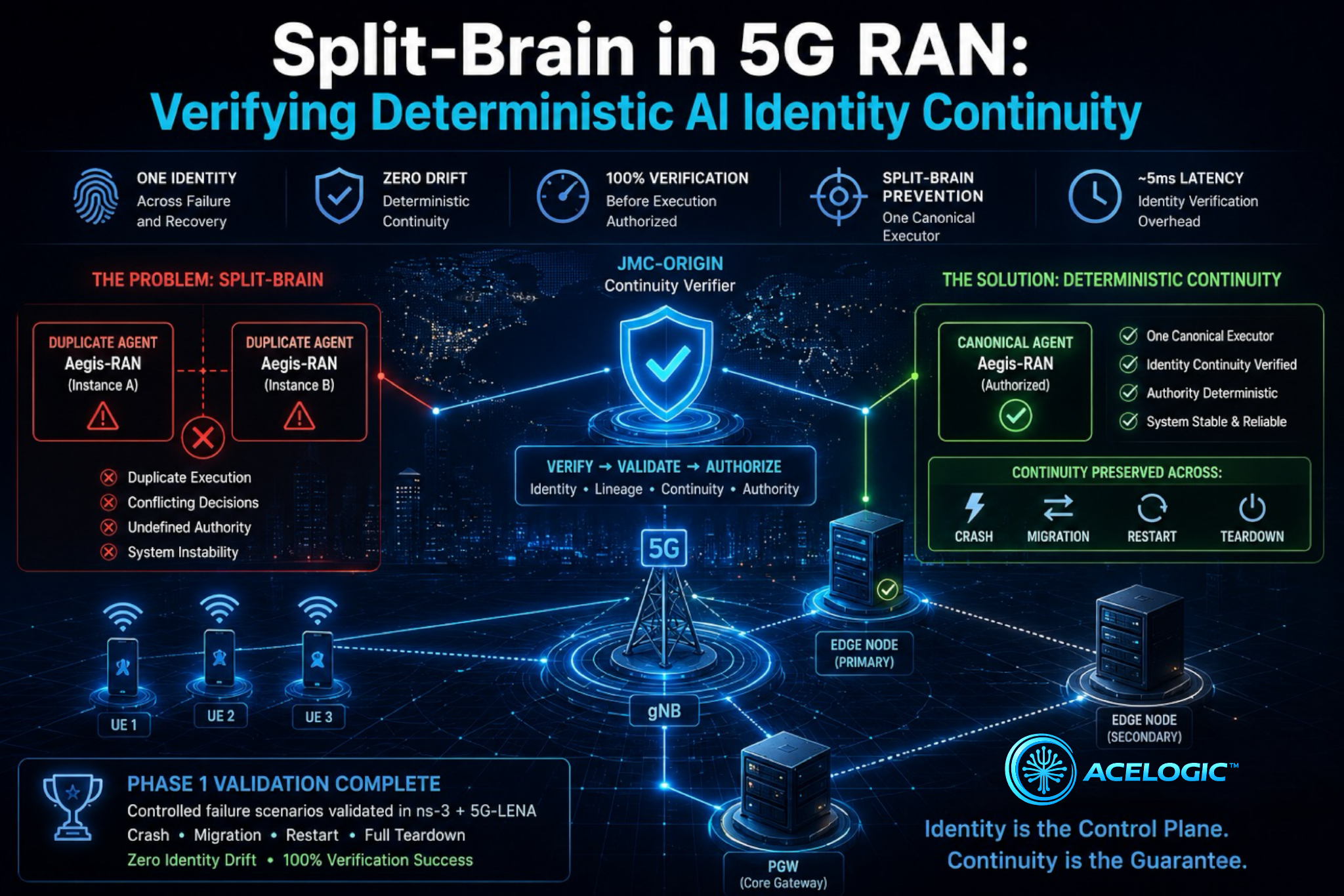
We intentionally induced split-brain conditions inside a simulated 5G NR distributed edge environment and verified deterministic identity continuity across:

  • crash
  • migration
  • restart
  • full teardown
  • redeployment

The result:

  • zero observed identity drift
  • zero unauthorized duplicate execution during continuity-enforced operation
  • 100% identity verification success across tested recovery events
  • successful identity continuity restoration after complete runtime destruction

This validation was conducted inside a simulated 5G NR environment using ns-3 and the 5G-LENA NR module.

Introduction

Distributed systems do not fail cleanly.

They fork.

After:

  • crash
  • restart
  • migration
  • partition
  • asynchronous recovery

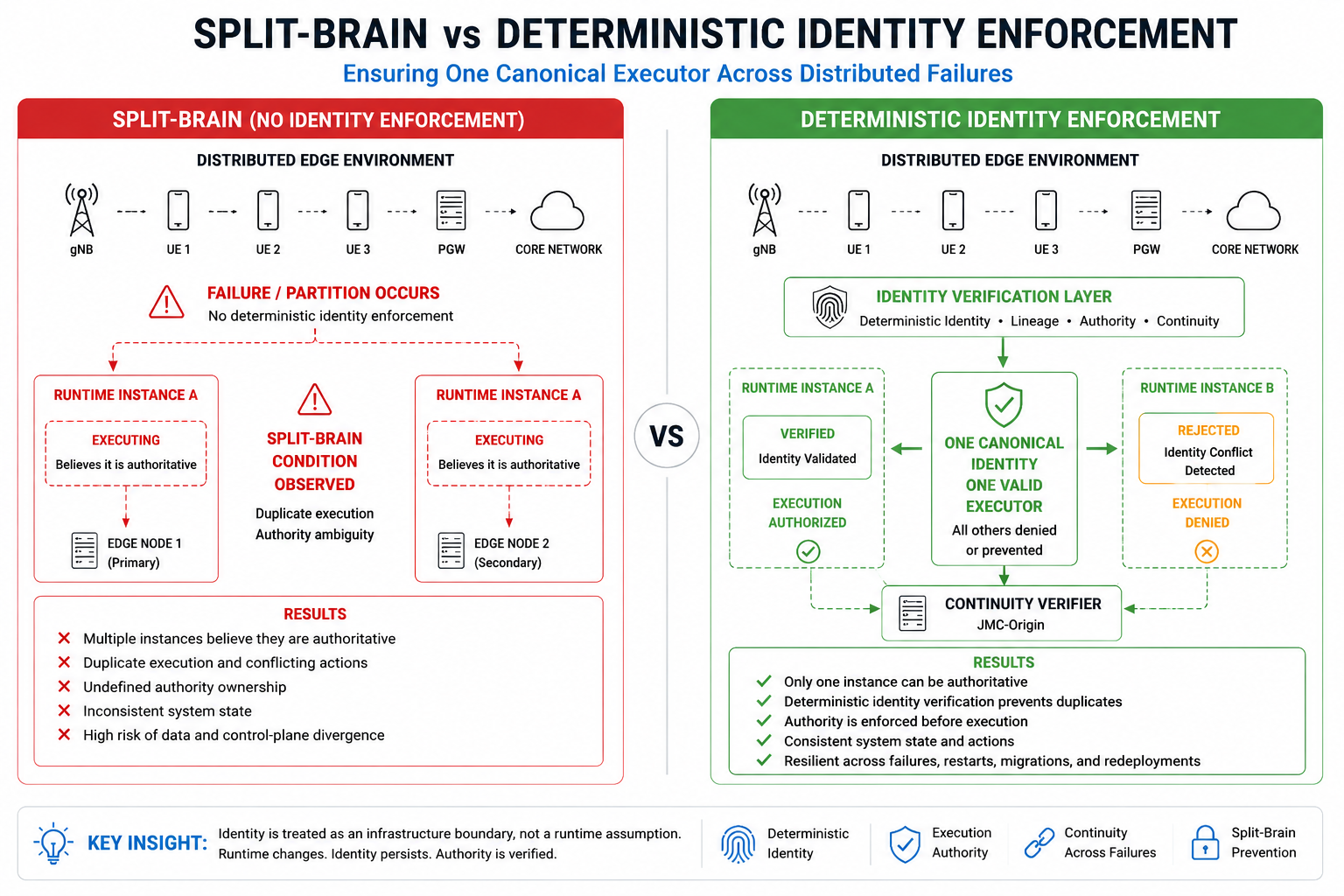
multiple runtime instances may simultaneously believe they are authoritative.

This creates:

  • split-brain execution
  • duplicate actions
  • authority ambiguity
  • inconsistent system state

As autonomous systems move into:

  • edge infrastructure
  • AI-RAN
  • distributed inference
  • multi-agent orchestration

identity continuity becomes an infrastructure problem rather than an application concern.

This Phase 1 validation explored a different systems model:

Deterministic Identity Continuity.

A model in which identity persists independently of:
  • runtime
  • process lifetime
  • node location
  • restart state

The Problem

Most distributed systems coordinate state.

Very few enforce canonical execution identity.

Conventional systems typically rely on:

  • leader election
  • quorum consensus
  • eventual consistency
  • orchestration scheduling

These mechanisms help coordinate distributed execution.

They do not guarantee:

  • one canonical executor
  • deterministic identity continuity
  • runtime-independent authority validation

This becomes especially problematic during:

  • node failure
  • duplicate activation
  • migration
  • restart
  • recovery

Without deterministic identity enforcement, systems may produce:

  • duplicate runtime instances
  • conflicting execution paths
  • stale recovery behavior
  • undefined authority ownership

Experimental Environment

The validation environment was implemented using:

  • ns-3.46
  • 5G-LENA (NR module)
  • NetAnim visualization
  • FlowMonitor telemetry collection

The simulated topology included:

  • one gNB
  • three UEs
  • PGW core gateway
  • primary edge node
  • secondary edge node
  • continuity verifier node

The environment simulated:

  • packet flow
  • latency
  • migration
  • node crash
  • restart
  • distributed execution recovery

using a controlled 5G NR infrastructure model.

The Core Idea

The validation introduced a deterministic identity model in which identity is treated as an infrastructure-level execution boundary.

Identity was defined independently from runtime state.

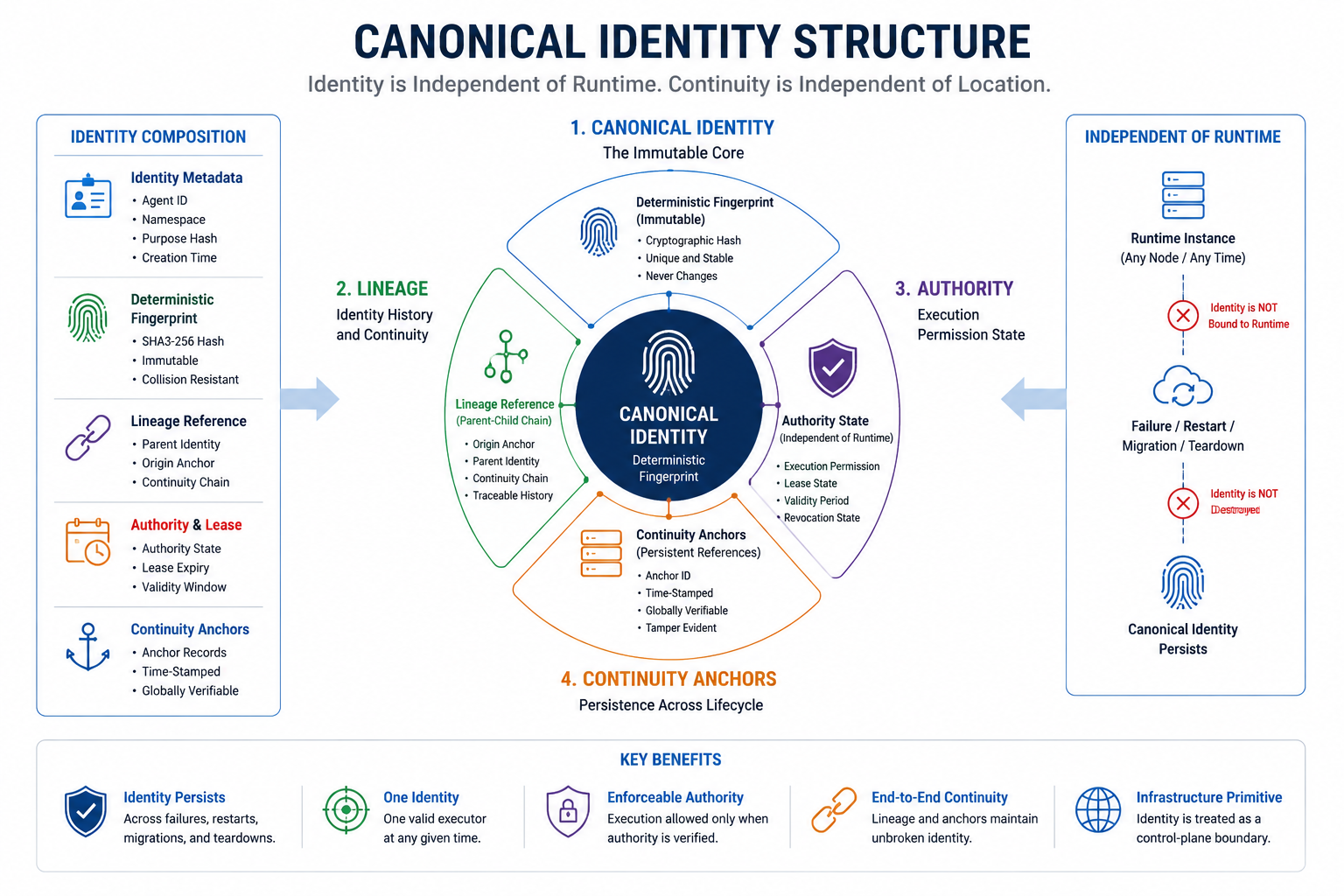
Each agent carried:

  • deterministic identity metadata
  • immutable lineage references
  • continuity anchors
  • authority state

This enabled the system to distinguish between:

  • runtime existence
    and:
  • canonical identity continuity

Meaning:

Restart ≠ new identity Migration ≠ identity loss Teardown ≠ identity destruction
Identity Architecture

The system modeled two autonomous agents:

Aegis-RAN

Enterprise execution agent responsible for network control behavior.

JMC-Origin

Continuity verifier responsible for validating identity continuity and lineage integrity.

The system separated:

Canonical Identity

Deterministic fingerprint derived from immutable metadata.

Lineage

Parent-child continuity reference chain.

Authority

Execution permission state independent of runtime existence.

This allowed identity continuity to persist across lifecycle disruption.
What Was Tested

The validation intentionally introduced controlled failure conditions.

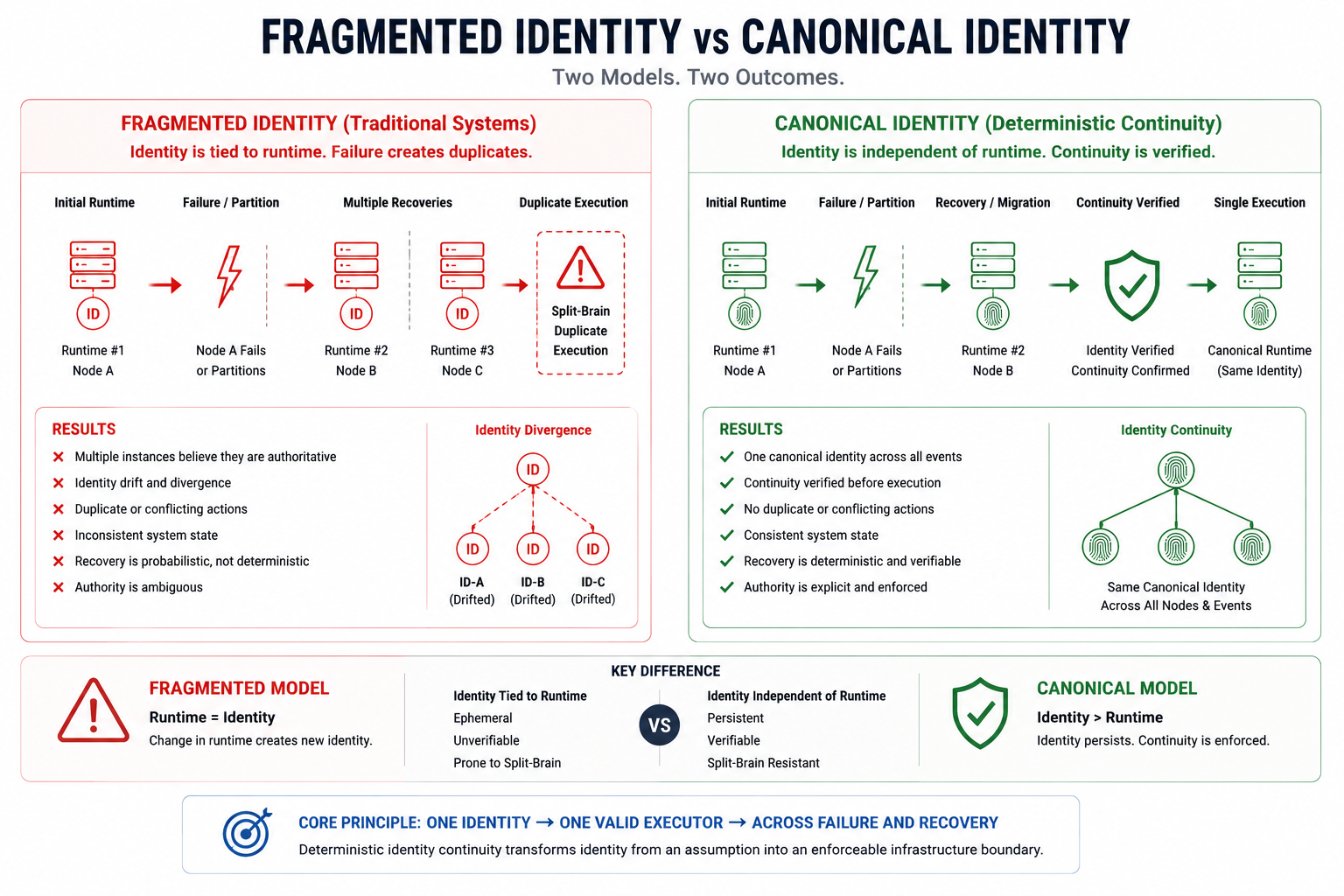
Baseline Condition (No Continuity Enforcement)

Two duplicate runtime instances executed simultaneously without verification.

Result:

  • split-brain condition observed
  • duplicate execution occurred

Continuity-Enforced Conditions

The system then validated deterministic continuity enforcement across four scenarios.
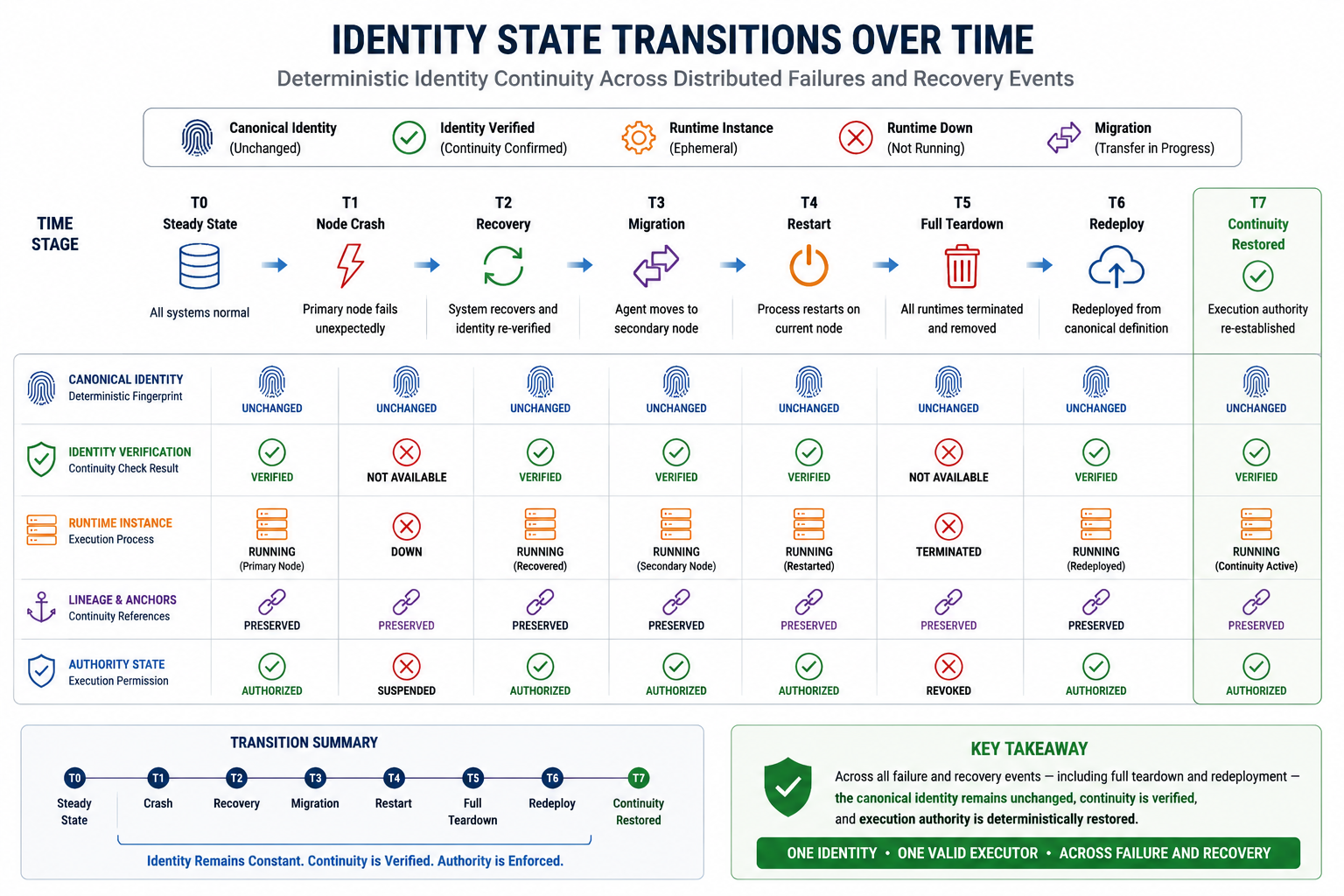
Scenario A- Node Crash

Agent instances terminated unexpectedly.

Recovery:

  • state restored
  • identity re-verified
  • execution authority restored

Result:

  • canonical continuity preserved
  • no identity drift observed

Scenario B-  Agent Migration

Agent transferred from primary edge node to secondary node.

Result:

  • identity unchanged
  • continuity preserved
  • execution resumed deterministically
  • no fragmentation occurred during node transition

Scenario C- Process Restart

Local runtime terminated and restarted on same node.

Result:

  • fingerprint unchanged
  • continuity verification succeeded
  • authority restored deterministically

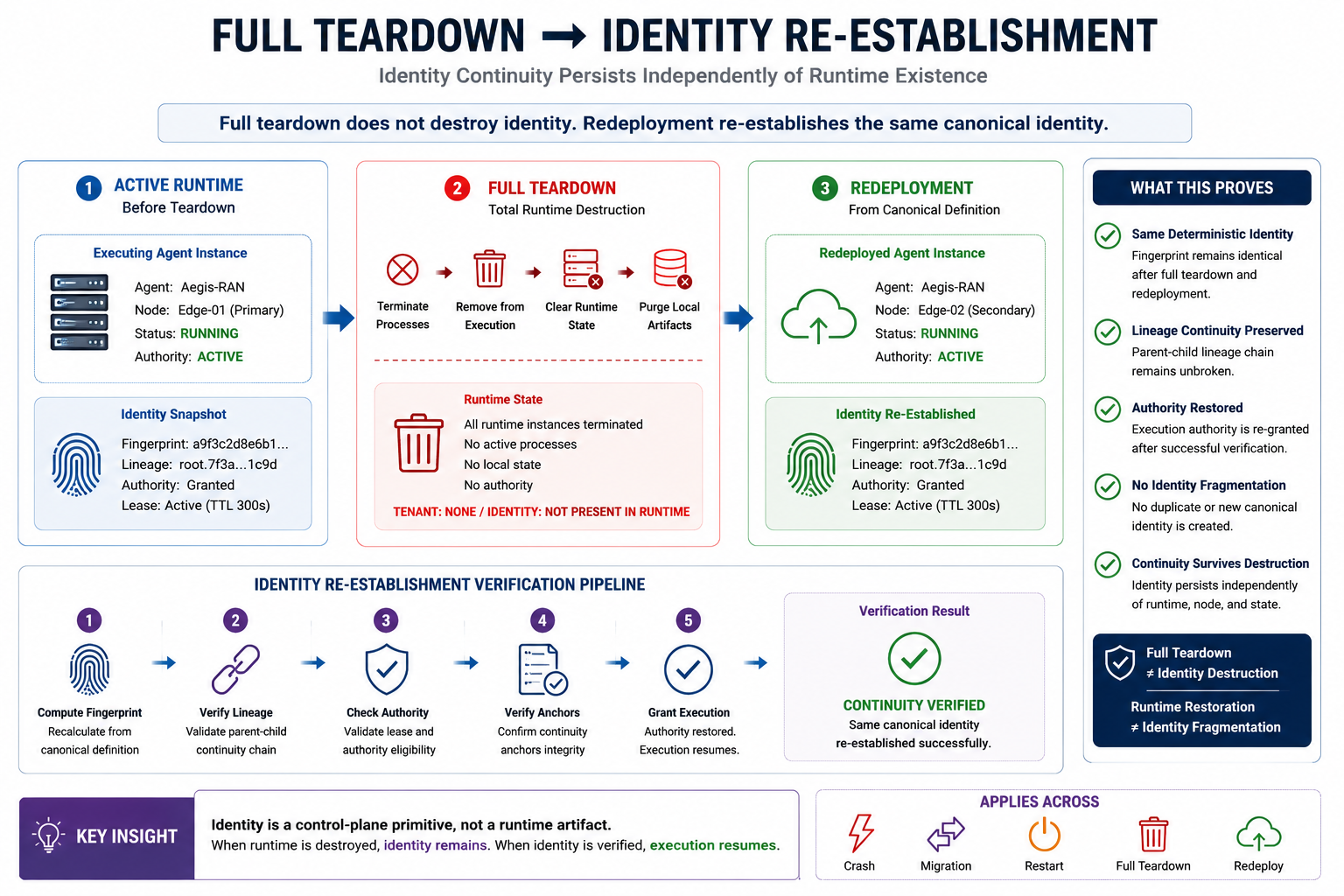
Scenario D- Full Teardown + Redeploy

One of the most significant validation events involved complete runtime destruction.

All active agent processes were intentionally:

  • terminated
  • removed from execution
  • cleared from runtime state

The environment then redeployed the agents from canonical identity definitions.

After redeployment:

  • the same deterministic identity was restored
  • the same lineage continuity was verified
  • execution authority was re-established
  • no identity fragmentation occurred
  • no secondary canonical identity emerged
  • no continuity divergence was detected

Importantly:

the restored runtime was not treated as a new entity.

Continuity verification confirmed deterministic re-establishment of the original canonical identity after total teardown.

This demonstrated that:
identity continuity persisted independently of:

  • process lifetime
  • runtime existence
  • node residency
  • execution state

The validation therefore established:

Full teardown
≠ identity destruction

and:

Runtime restoration ≠ identity fragmentation
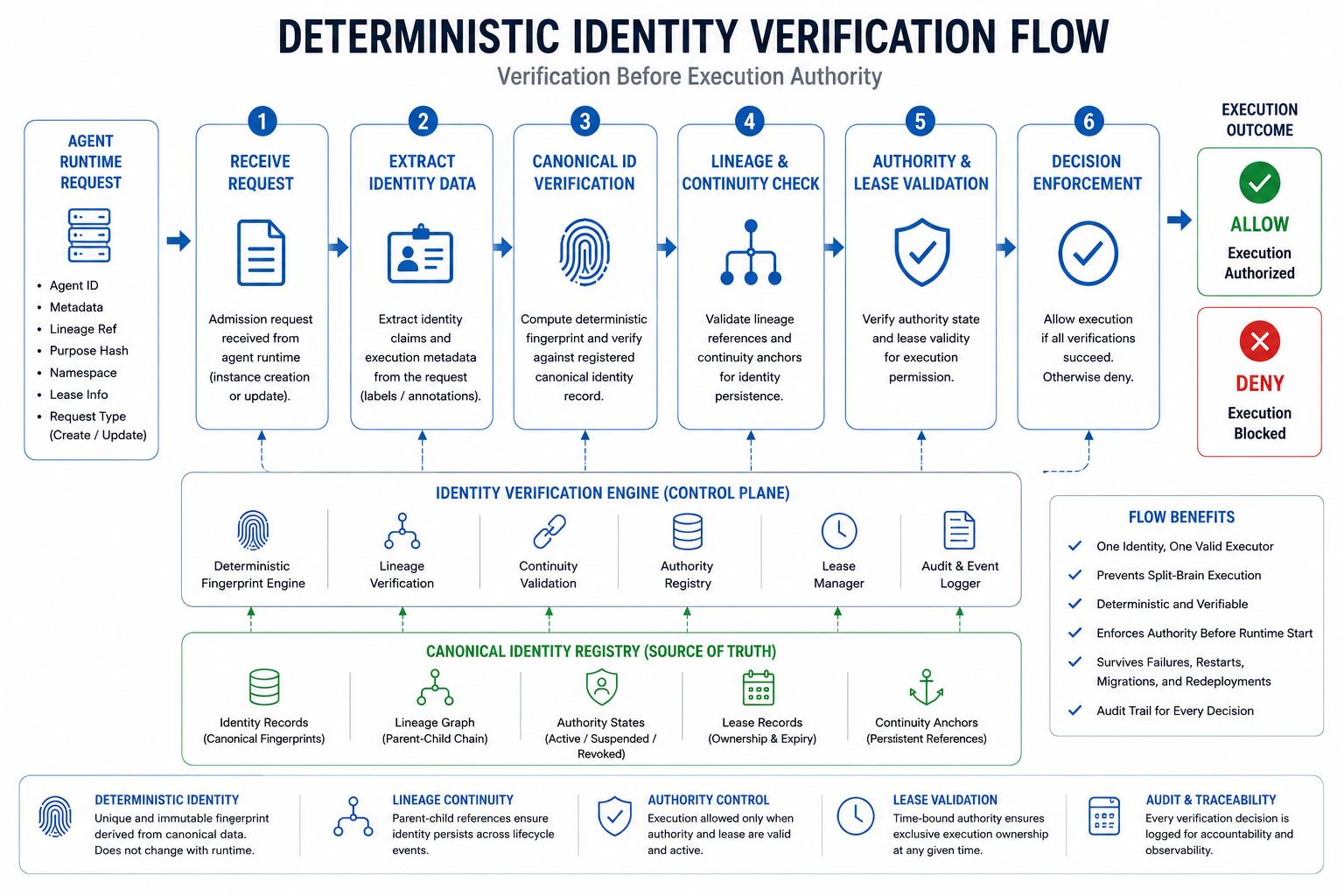
Verification Model

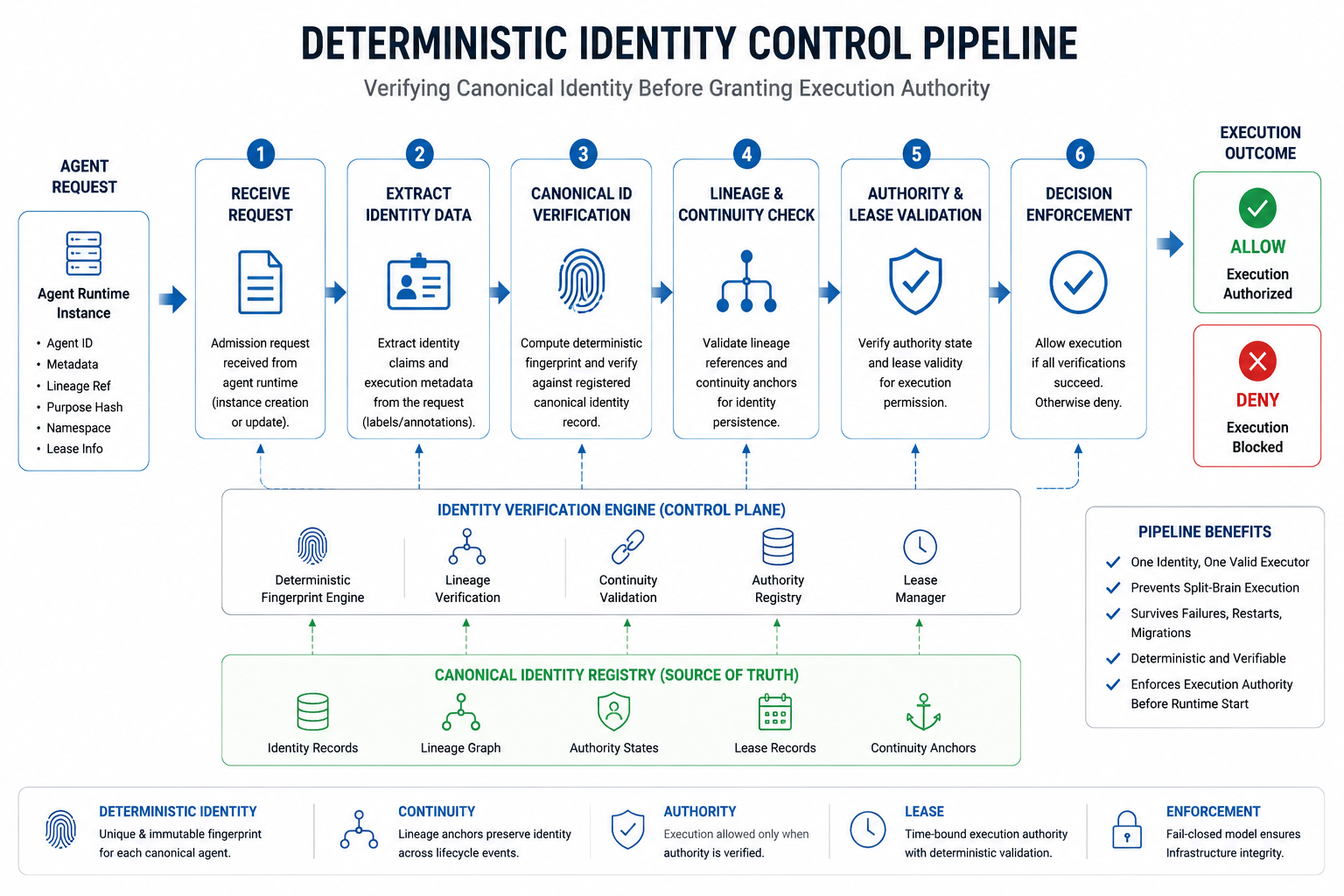
Identity verification occurred before execution authority was granted.

Verification included:

  • deterministic fingerprint validation
  • lineage verification
  • continuity validation
  • authority confirmation

Execution proceeded only after continuity verification succeeded.

This enforced:

One Identity → One Valid Executor → Across Failure and Recovery
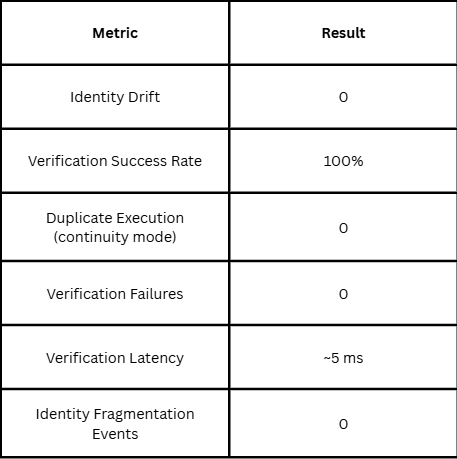
Validation Metrics

Verification Results

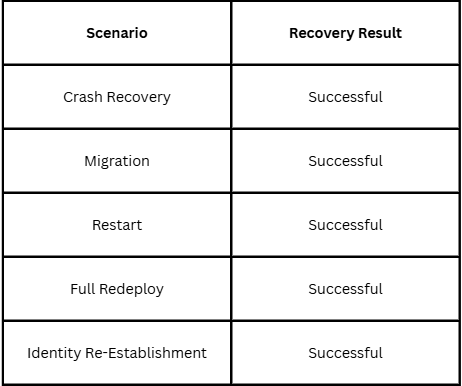
Recovery Events

All continuity verification events succeeded during tested lifecycle disruptions.

What This Demonstrated

The validation demonstrated that:

  • identity can persist independently of runtime existence
  • duplicate execution can be deterministically constrained
  • continuity can survive restart and migration
  • authority can be gated through identity verification
  • execution continuity can persist across teardown and redeployment
  • full runtime destruction does not inherently produce identity fragmentation
  • canonical continuity can be deterministically re-established after complete redeployment

Most importantly:

identity continuity remained stable even while runtime instances changed.
Architectural Insight

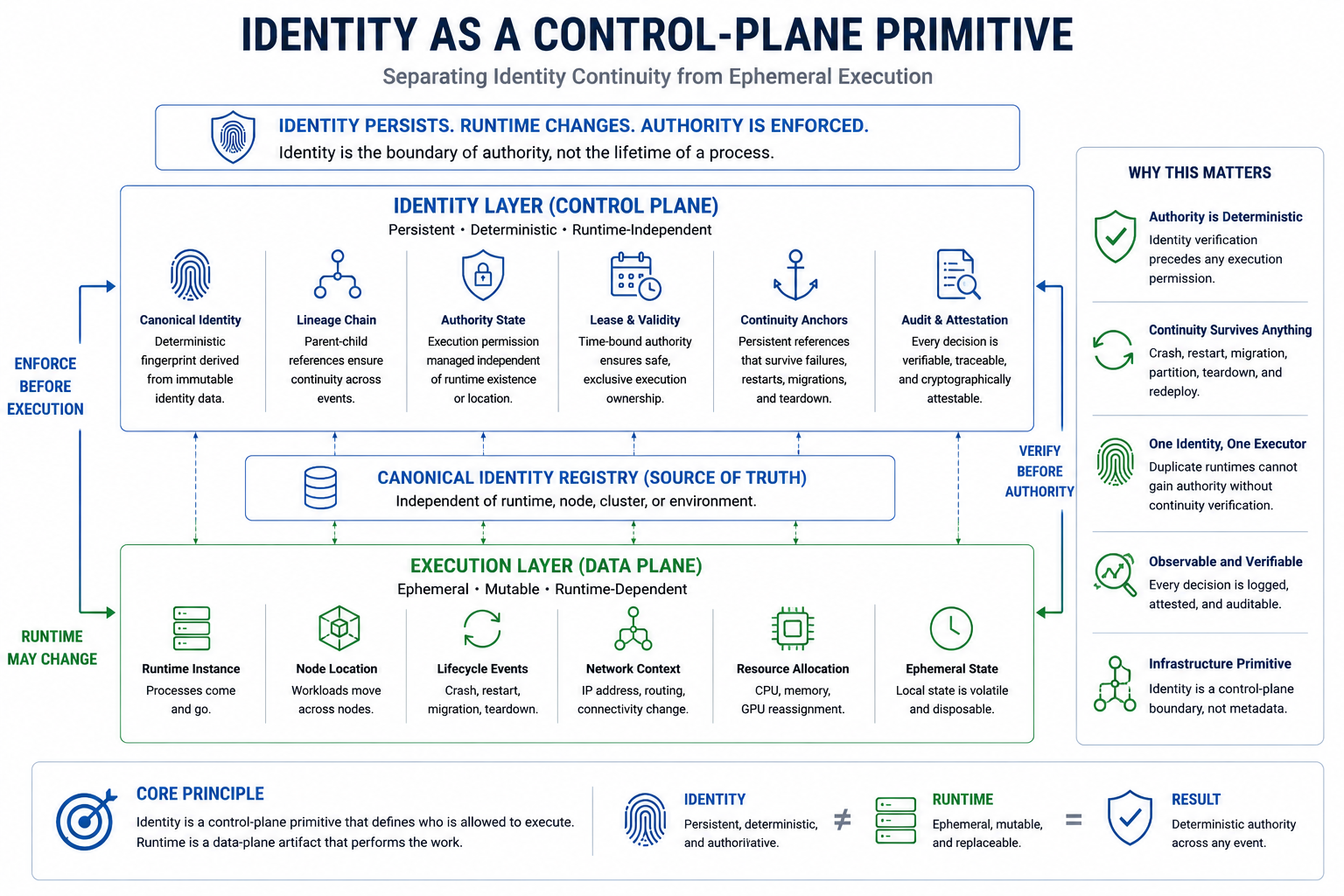
One of the key findings was the separation between:

Identity Layer

Canonical identity continuity and authority verification.

and:

Execution Layer

Ephemeral runtime processes and node placement.

This separation allowed:

  • runtime destruction
    without:
  • identity destruction

The system therefore treated identity as: a control-plane primitive, not merely metadata.
What This Validation Does NOT Claim

This Phase 1 validation did not attempt to demonstrate:

  • telecom production deployment
  • throughput optimization
  • network acceleration
  • Byzantine fault tolerance
  • adversarial security resistance
  • cryptographic consensus
  • blockchain infrastructure
  • production-grade distributed coordination

The validation focused specifically on:

deterministic identity continuity under controlled distributed failure conditions.

Why This Matters

As systems evolve toward:

  • autonomous agents
  • edge-native AI
  • AI-RAN infrastructure
  • distributed orchestration
  • multi-agent execution

the cost of identity ambiguity increases significantly.

Without deterministic identity:

  • execution authority becomes ambiguous
  • duplicate runtimes become difficult to constrain
  • continuity becomes probabilistic
  • accountability becomes unclear

This validation explored a systems model where: identity itself becomes enforceable infrastructure.

Evolution Toward ACELOGIC™

This Phase 1 validation established the foundational continuity model inside a controlled 5G edge simulation environment.

Subsequent ACELOGIC™ infrastructure development expands these concepts into:

  • Kubernetes-native admission enforcement
  • deterministic runtime authority validation
  • lease-based execution control
  • SAFE_MODE enforcement
  • split-brain prevention
  • partition-safe reconciliation
  • multi-cluster continuity governance

The current ACELOGIC™ architecture builds directly upon the deterministic continuity principles validated in this research environment.

Final Observation

An autonomous system can lose:

  • its runtime
  • its process
  • its host
  • its execution state

and still be deterministically verified as the same canonical entity.

That changes identity from:
a runtime assumption

into: an enforceable infrastructure boundary.