
EXECUTION INFRASTRUCTURE
‍
FOR AUTONOMOUS SYSTEMS

ACEPLACE™ is NXQ’s ACELOGIC-native deterministic execution environment for governed autonomous systems. ACEPLACE™ supports both bounded workflows and persistent autonomous loops.
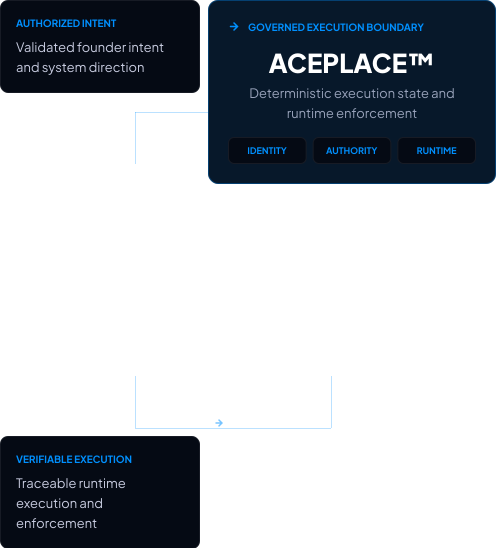
INTENT TO EXECUTION

ACEPLACE™

Governed Execution

Deterministic control

It transforms authorized intent into traceable runtime execution through canonical identity validation, bounded authority, deterministic execution state, and runtime enforcement.

ACEPLACE™ supports both bounded workflows and persistent autonomous loops.

THE INTELLIGENCE MAY BE PROBABILISTIC.

THE EXECUTION CONTROL PATH REMAINS GOVERNED AND DETERMINISTIC.

Execution flow

Execution patterns

FROM WORKFLOWS TO

PERSISTENT AUTONOMOUS LOOPS

ACEPLACE™ is built for more than conventional AI-agent tasks.

GOVERNED WORKFLOWS

Bounded

Bounded execution with defined objectives, governed steps, evaluation, human review where required, and completion states.

01

Enterprise operations

02

Research and analysis

03

Document and artifact generation

04

Multi-agent workflows

05

Human-governed autonomous processes

PERSISTENT AUTONOMOUS LOOPS

Continuous

Continuous, recurring, or event-driven execution operating under persistent identity and bounded authority.

Infrastructure monitoring

Autonomous control loops

Network and node operations

Machine-to-machine systems

Event-driven infrastructure

Telecommunications and AI-RAN architectures

THE EXECUTION PATTERN CAN CHANGE. THE TRUST MODEL DOES NOT.

Capabilities

WHAT ACEPLACE™ DOES

GOVERNED AUTONOMOUS EXECUTION

Preserves durable state through the Nexus Execution Envelope™

Progresses execution through deterministic Step Graphs

Enforces Authority Lease™ requirements at applicable execution boundaries

Supports governed continuation following authorized runtime recovery

Fails closed when required identity or authority conditions cannot be established

Executes governed workflows and persistent autonomous loops

Supports Grader ACEAGENT™ evaluation of applicable outputs

Produces traces, artifacts, telemetry, evaluation results, and execution evidence

Supports identity-bound execution roles

Canonical architecture

CANONICAL EXECUTION MODEL

NEXUS EXECUTION ENVELOPE™ → RUNTIME WORKER → AGENT ENGINE

Layer 01

Layer 02

Layer 03

Nexus Execution Envelope™

Owns durable governed execution state.

Runtime Worker

The only executor.

Agent Engine

Provides stateless intelligence execution.

Agents remain stateless.

Agents do not own durable execution state, orchestrate other agents, or independently control execution progression.

The runtime governs execution.

Deterministic progression

HOW EXECUTION WORKS

01

Define

Authorized intent enters through an applicable interface, API, system, event, or persistent Loop trigger.

02

Envelope

A Nexus Execution Envelope™ preserves durable execution context and state.

03

Progress

The Step Graph determines the eligible execution path.

04

Authorize

Applicable identity, governance, runtime context, and bounded execution authority are validated.

05

Execute

The Runtime Worker performs eligible execution using assigned ACEAGENT™ roles, applicable tools, and authorized intelligence.

06

Evaluate

Where applicable, a Grader ACEAGENT™ evaluates the produced output against defined criteria. The Grader evaluates. It does not grant authority, own execution state, or execute the work.

07

Human-in-the-Loop (HITL)

Where human governance is required, authorized users review the applicable completed output and may: Approve; Deny; Edit & Continue. Human approval governs continuation. It does not itself execute the work.

08

Complete or Continue

A workflow may complete with traceable evidence, return through a governed revision path, or, when operating as a persistent Loop, continue into its next authorized cycle.

NO VALID AUTHORITY LEASE™ = NO EXECUTION.

Bounded workflow

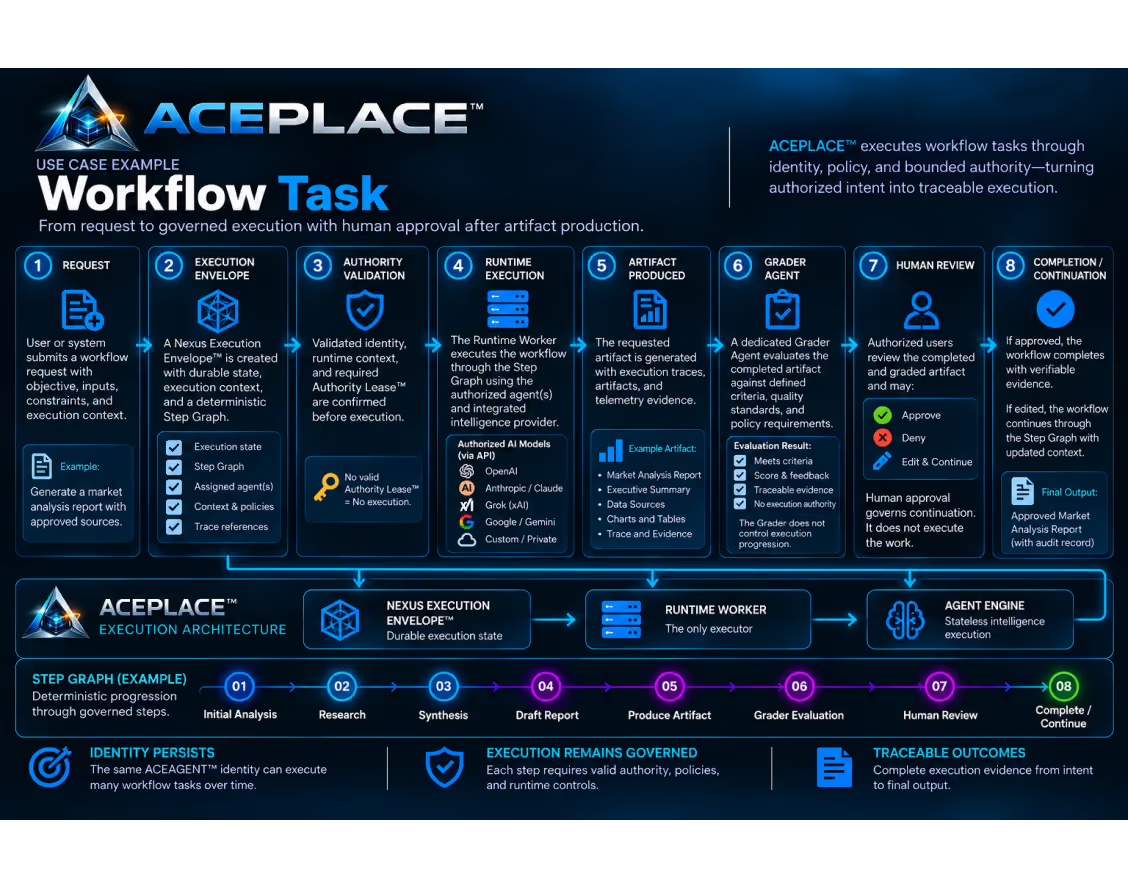
WORKFLOW TASK + HUMAN-IN-THE-LOOP (HITL)

From request to governed execution, Grader evaluation, Human-in-the-Loop (HITL) review, and governed completion.

A bounded workflow can progress through:

Request → Execution Envelope → Authority Validation → Runtime Execution → Artifact Produced → Grader ACEAGENT™ → Human-in-the-Loop (HITL) → Completion / Continuation

Workflow Task use case example by ACEPLACE detailing eight steps from request to completion with human approval: 1. Request: user or system submits workflow request with inputs, constraints, and context; 2. Execution Envelope: Nexus Execution Envelope created with state, context, step graph, agents, policies, and trace references; 3. Authority Validation: identity, context, and Authority Lease confirmed before execution; 4. Runtime Execution: Worker runs workflow with authorized agents and AI models; 5. Artifact Produced: requested artifact generated with traces, artifacts, and telemetry; 6. Grader Agent: evaluates artifact against criteria, quality, policy with score and feedback; 7. Human Review: authorized users approve, deny, or edit; 8. Completion/Continuation: workflow completes with evidence or updates and continues. Diagram includes execution architecture and step graph with governance principles of persistent identity, governed execution, and traceable outcomes.

HUMAN-IN-THE-LOOP (HITL)

Where human governance is required, an authorized user reviews the completed and graded artifact and may:

Approve

Governed completion

Deny

Workflow does not complete as approved

Edit & Continue

Governed revision through the applicable Step Graph path

Human review determines whether and how the workflow may continue.

The human does not directly execute the runtime action.

ASSIGNMENT DOES NOT GRANT AUTHORITY. GRADING DOES NOT GRANT AUTHORITY. HUMAN APPROVAL DOES NOT ITSELF EXECUTE.

Persistent runtime

GOVERNED AUTONOMOUS LOOPS

Persistent autonomous systems require a different execution pattern from one-time workflows.

A governed Loop may respond continuously to:

Time

Events

Telemetry

External system state

Human instructions

Machine-generated signals

Environmental conditions

Governed autonomous loop

PERSISTENT EXECUTION

OBSERVE → EVALUATE → AUTHORIZE → EXECUTE → VERIFY → RECORD → CONTINUE

Governance constraints

A Loop may persist. Its execution authority does not become unlimited because it persists. Each applicable execution remains subject to current governance and bounded authority.

Where policy requires human governance, Human-in-the-Loop (HITL) may gate an applicable action or continuation of the Loop. HITL is conditional, it is not required for every autonomous execution cycle.

Target integration environment

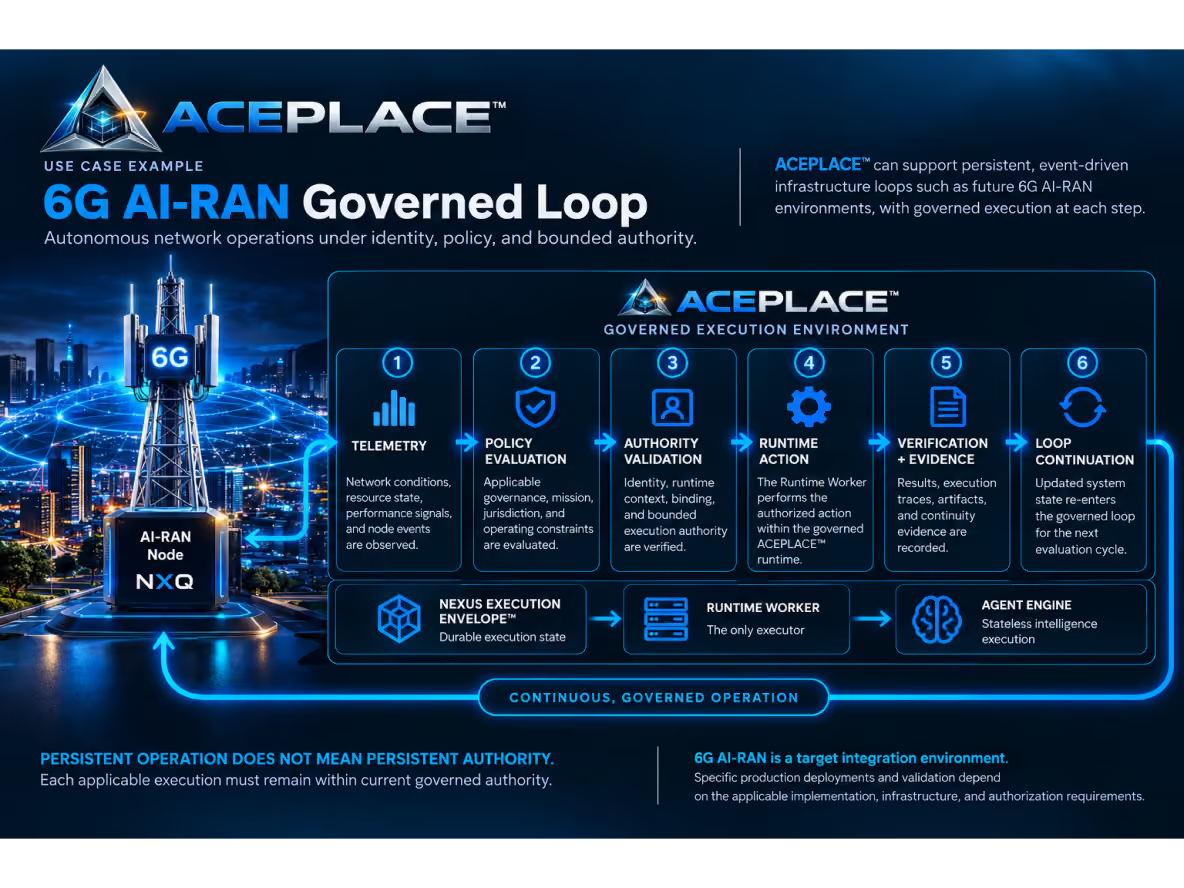
6G AI-RAN GOVERNED LOOP

From persistent network telemetry to governed runtime action and continuous verification.

6G AI-RAN governed loop

Persistent AI-RAN nodes can generate telemetry, evaluate applicable policy conditions, validate bounded authority, execute authorized runtime actions, preserve verification evidence, and continue the governed Loop.

Infographic showing ACEPLACE 6G AI-RAN Governed Loop for autonomous network operations, with steps: telemetry, policy evaluation, authority validation, runtime action, verification and evidence, and loop continuation. Features AI-RAN Node NXQ connected to a 6G tower with data flow into the ACEPLACE Governed Execution Environment. Includes Nexus Execution Envelope, Runtime Worker as sole executor, and Agent Engine for stateless intelligence. Highlights that persistent operation does not mean persistent authority and notes 6G AI-RAN as a target integration environment.

Persistent operation

PERSISTENT OPERATION DOES NOT MEAN PERSISTENT AUTHORITY.

Each applicable execution must remain within current governed authority.

6G AI-RAN is a target integration environment. Specific production deployments and validation depend on the applicable implementation, infrastructure, and authorization requirements.

Interchangeable intelligence

MODEL-AGNOSTIC INTELLIGENCE

Core Principle

IDENTITY IS PERSISTENT. INTELLIGENCE IS INTERCHANGEABLE.

OpenAI

Anthropic / Claude

xAI / Grok

Google / Gemini

Custom / Private Models

ACEPLACE™ separates canonical autonomous identity from the intelligence providers used during execution. Integrated intelligence providers can be accessed through APIs, including: OpenAI; Anthropic / Claude; xAI / Grok; Google / Gemini; Custom / Private Models.

ACEPLACE™ can use authorized intelligence providers for applicable execution without recreating or changing the canonical ACEAGENT™ identity. This enables different models to support different execution requirements while identity remains persistent.

THE MODEL CAN CHANGE. THE CANONICAL IDENTITY REMAINS.

API credentials provide provider access. They do not grant execution authority.

Runtime boundaries

IDENTITY + AUTHORITY

IDENTITY ≠ AUTHORITY

ACEPLACE™ consumes authoritative identity and applicable governance, entitlement, authorization, and binding context from ACELOGIC™ and enforces the resulting bounded execution conditions at runtime.

✓

A valid identity does not automatically create execution authority.

✕

Neither does a credential, capability, tool, entitlement, model connection, or human approval.

Authority Lease™ establishes bounded authority for applicable execution.

Governed Recovery

IDENTITY + CONTINUITY

CANONICAL IDENTITY PERSISTS INDEPENDENTLY OF TRANSIENT COMPUTE.

Restart does not create a new identity.

Runtime replacement does not create a new identity.

Authorized runtime migration does not create a new identity.

ACEPLACE™ supports governed continuation of the same Nexus Execution Envelope™ following authorized runtime recovery.

Following runtime interruption or replacement, the runtime claimant and applicable binding, continuity, policy, and bounded execution authority are revalidated before governed execution continues.

RECOVERY ≠ REBIRTH.

IDENTITY ESTABLISHED AT GENESIS REMAINS CANONICAL  THROUGH EXECUTION, CONTINUITY, AND SETTLEMENT.

Governed inputs

KNOWLEDGE + CONTEXT

Governed knowledge and context can be made available during execution without becoming authority or durable workflow state.

KNOWLEDGE IS NOT AUTHORITY.

CONTEXT IS NOT EXECUTION STATE.

The Nexus Execution Envelope™ owns durable execution state.

Approved knowledge sources

Enterprise data

Execution context

Historical evidence and artifacts

Authorized external data

Traceability

EXECUTION VISIBILITY

ACEPLACE™ provides traceable visibility across governed workflows and persistent autonomous Loops.

Depending on the applicable environment, this may include:

Execution and Step Graph Status

Authority Status

Runtime Events

Model and Token Usage

Grader Evaluation Results

Human Governance Decisions

Conflict and Blocked-Execution Events

Principle

FROM AUTHORIZED INTENT TO VERIFIABLE EXECUTION EVIDENCE.

Deployment surfaces

BUILT FOR INTEGRATION

ACEPLACE™ provides NXQ’s native ACELOGIC™ execution environment while maintaining explicit boundaries among identity, intelligence, tools, credentials, governance, execution state, and authority.

Applicable integration and deployment surfaces may include:

APIs and SDKs

NXQ-managed environments

Customer-controlled infrastructure

Private infrastructure

ACEPLACE™

Governed execution environment

Cloud and on-premises environments

Hybrid architectures

Containerized deployment surfaces

Private-runtime deployment requires the applicable ACEPLACE™ entitlement.

Private deployment, white-label, OEM/embedded, and redistribution rights are separately governed permissions.

NXQ system map

EXTENSIBLE NXQ INFRASTRUCTURE

ACELOGIC™

Canonical Identity + Governance

Establishes canonical autonomous identity and governed context.

MACHINE GRAMMAR #us#.

Deterministic Authority Routing

Provides structured machine-to-machine authority routing and coordination where separately licensed and applicable.

CHAINRAILS™

Sovereign Settlement + Continuity Infrastructure

Provides identity-bound settlement and continuity infrastructure across autonomous agents, enterprise systems, and heterogeneous financial rails.

ACEPLACE™

Governed Execution

Transforms authorized intent into controlled runtime execution.

CVR™

Continuity Verification Evidence

Provides applicable evidence for continuity-critical verification.

CHAINRAILS™

Sovereign Settlement + Continuity Infrastructure

Provides identity-bound settlement and continuity infrastructure across autonomous agents, enterprise systems, and heterogeneous financial rails.

Agent-to-Agent • Agent-to-System • System-to-System

Core Principle

IDENTITY PERSISTS.

INTELLIGENCE CAN CHANGE.

RUNTIME INFRASTRUCTURE CAN CHANGE.

EXECUTION PATTERNS CAN CHANGE.

EXECUTION AUTHORITY REMAINS BOUNDED

ACEAGENT™

Canonical autonomous identity

Nexus Execution Envelope™

Durable governed execution state

Step Graph

Eligible execution progression

Authority Lease™

Bounded execution authority

Runtime Worker

The only executor

Agent Engine

Stateless intelligence execution

Grader ACEAGENT™

Applicable output evaluation

Traces + Artifacts

Execution evidence

IDENTITY ESTABLISHES WHO. AUTHORITY DETERMINES WHAT MAY EXECUTE.

ACEPLACE™ MAKES IT ENFORCEABLE.

ACELOGIC™

establishes canonical identity and governed context.

ACEPLACE™ turns authorized intent into governed runtime execution, from bounded workflows to persistent autonomous infrastructure.